
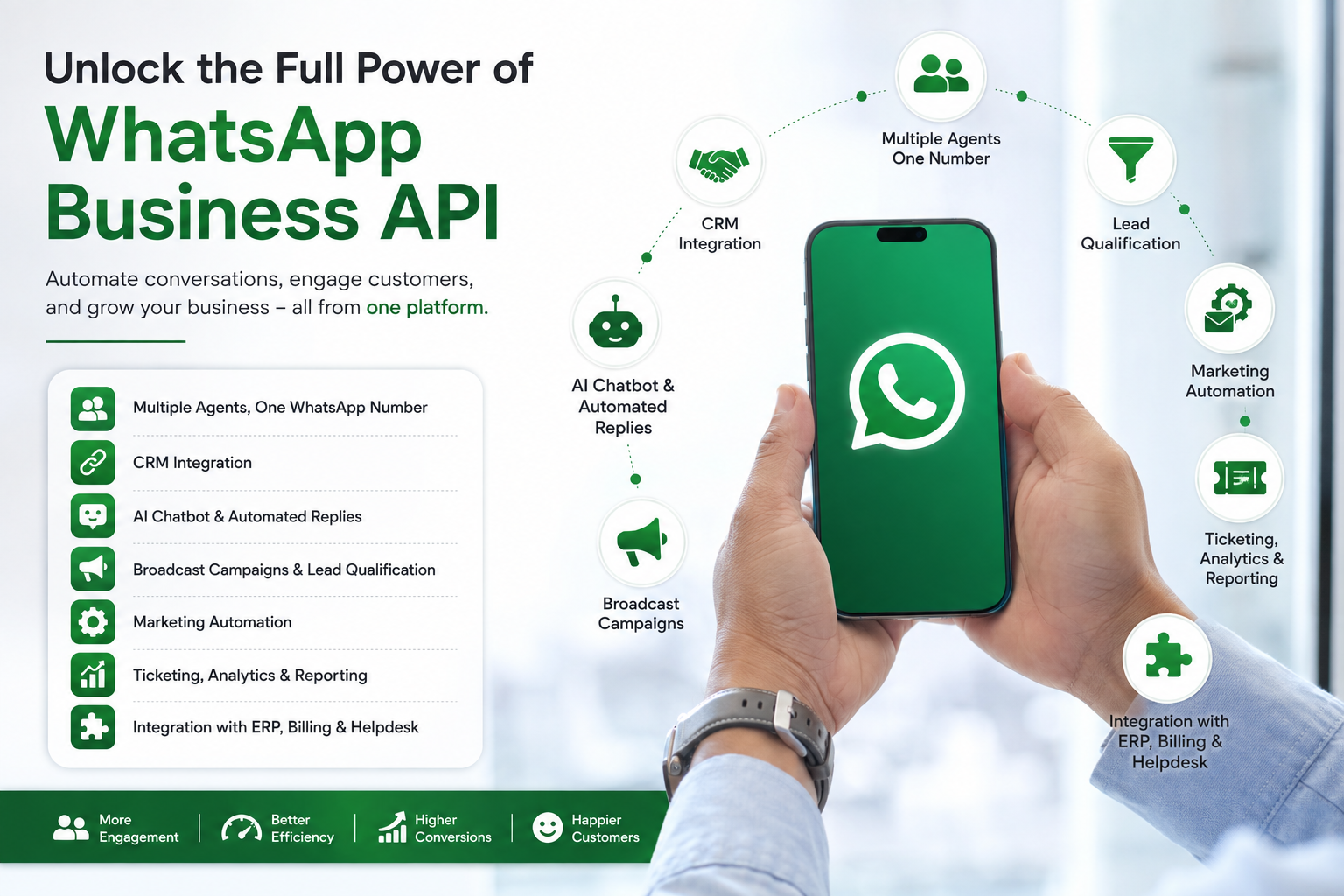
Complete Guide to WhatsApp Business API Features
The WhatsApp Business API is much more than a messaging platform. It acts as the communication bridge between your customers and your business systems, enabling sales, marketing, customer support, operations, and service teams to collaborate using a single WhatsApp number while automating repetitive tasks and improving customer experiences.
Whether you are a growing startup or a large enterprise, the WhatsApp Business API helps businesses manage customer conversations efficiently, automate workflows, and integrate with existing CRM, ERP, billing, and helpdesk systems.
1. Multiple Agents Handling One WhatsApp Number
The Problem
The standard WhatsApp Business App is primarily designed for small businesses with limited customer interactions. As your business grows, managing customer communication through a single mobile device becomes increasingly difficult.
The common limitations include:
- Only one primary mobile number.
- A limited number of linked devices.
- No proper team collaboration.
- No visibility into which employee replied to a customer.
- Chats remain stored on individual devices.
- Customers often receive delayed or inconsistent responses.
Imagine your business receives:
- 300 customer enquiries every day
- 50 customer support tickets
- 100 order status requests
- 40 new sales enquiries
Expecting a single employee to manage every conversation quickly becomes impossible. Missed messages, delayed responses, and frustrated customers become everyday challenges.
How the WhatsApp Business API Solves It
Instead of connecting your WhatsApp number to a mobile phone, the WhatsApp Business API connects it to a shared inbox or customer communication platform. Every authorised employee can access and respond to customer conversations simultaneously using the same WhatsApp number.
For example, your organisation could have:
- Sales Team – 5 users
- Customer Support – 8 users
- Accounts Team – 2 users
- Service Team – 6 users
- Managers – 3 users
Every department works collaboratively while customers continue interacting with a single verified business number.
Key Features
- Multiple or unlimited agents (depending on the platform)
- Role-based access control
- Internal team notes
- Automatic conversation assignment
- Chat transfer between departments
- Supervisor monitoring
- Team performance tracking
- Complete conversation history
Business Benefits
- ✔ Faster response times
- ✔ No missed customer enquiries
- ✔ Better customer experience
- ✔ Improved team accountability
- ✔ Increased sales conversion
2. CRM Integration
What is CRM?
CRM (Customer Relationship Management) software stores and organises customer information, helping businesses maintain long-term relationships and improve sales efficiency.
Typical customer information stored inside a CRM includes:
- Customer Name
- Mobile Number
- Email Address
- Company Name
- Purchase History
- Lead Status
- Previous Conversations
- Assigned Sales Representative
Popular CRM platforms include:
- Salesforce
- Zoho CRM
- HubSpot
- Microsoft Dynamics
- Pipedrive
- Freshsales
Without CRM Integration
Without CRM integration, sales representatives manually perform repetitive administrative tasks such as:
- Saving customer contacts
- Copying WhatsApp conversations
- Updating spreadsheets
- Creating follow-up reminders
These manual processes consume valuable selling time and often result in duplicate entries, missed follow-ups, and inconsistent customer records.
With WhatsApp CRM Integration
When the WhatsApp Business API is integrated with your CRM, customer information becomes instantly available the moment a conversation begins.
Example:
Need quotation for 500 chairs.
The CRM immediately displays:
- Company: ABC Interiors
- Previous Orders: ₹12 Lakhs
- Last Purchase: March 2026
- Assigned Salesperson: Rahul
- Pending Payment: ₹50,000
The salesperson immediately understands the customer's history and can continue the conversation without asking repetitive questions.
What Can Be Automated?
- Automatic lead creation
- Contact creation
- Deal creation
- Follow-up reminders
- Sales pipeline updates
- Quotation generation
- Task assignment
- Sales reporting
Business Benefits
- ✔ Elimination of duplicate customer records
- ✔ Complete customer history in one place
- ✔ Faster sales process
- ✔ Improved follow-up management
- ✔ Higher sales productivity
3. AI Chatbot Support
Traditional Customer Support
Many businesses receive hundreds of repetitive customer enquiries every day. Customer support teams repeatedly answer the same questions, consuming valuable time that could be spent resolving complex customer issues.
Typical conversations include:
Customer:
What are your prices?
An employee manually replies.
Customer:
Where is my order?
An employee checks the ERP system before replying.
Customer:
What are your business hours?
Another manual response is sent.
When hundreds of customers ask similar questions every day, support teams become overloaded and response times increase.
How AI Chatbots Help
An AI-powered WhatsApp chatbot understands natural language and responds intelligently to customer enquiries without requiring human intervention.
Example 1
Customer:
I want to book an appointment.
AI Bot:
Sure. Please choose your preferred date and time.
Example 2
Customer:
I need 500 square feet of tiles.
AI Bot:
What size would you prefer?
What colour are you looking for?
Which city should we deliver to?
After collecting the required information, the chatbot automatically forwards the qualified enquiry to the appropriate sales representative.
What AI Chatbots Can Handle
- Frequently Asked Questions (FAQs)
- Product recommendations
- Appointment booking
- Order tracking
- Complaint registration
- Lead qualification
- Document collection
- Payment links
- Multi-language customer conversations
Business Benefits
- ✔ 24×7 customer support
- ✔ Instant responses
- ✔ Reduced manpower requirements
- ✔ Higher customer satisfaction
- ✔ Better lead management
4. Automated Replies
What Are Automated Replies?
Not every customer interaction requires Artificial Intelligence. Many business conversations follow predictable patterns that can be handled using predefined rules. Automated replies allow businesses to instantly respond whenever specific conditions are met, ensuring customers receive immediate acknowledgement even when employees are unavailable.
The Problem
Imagine a real estate developer running Facebook and Google Ads every weekend. Most enquiries arrive after business hours, between 8:00 PM and midnight, when the sales office is closed.
Potential customers send messages asking for brochures, pricing, or site visit details but receive no response until the following morning. By then, many prospects have already contacted competing developers who responded faster.
Delayed communication often results in:
- Lost sales opportunities
- Poor customer experience
- Lower trust in the brand
- Reduced lead conversion rates
How Automated Replies Solve It
The WhatsApp Business API allows businesses to create automated responses based on triggers such as keywords, business hours, order status, appointments, or payment confirmations.
Example 1: Welcome Message
Customer:
Hi
Automatic Reply:
Welcome to ABC Company.
Thank you for contacting us. How may we assist you today?
Example 2: After Business Hours
Automatic Reply:
Thank you for your message.
Our office is currently closed.
Business Hours: 9:00 AM – 6:00 PM
We'll get back to you as soon as we reopen.
Example 3: Order Dispatch
Great news! Your order has been shipped and is on its way.
Example 4: Appointment Confirmation
Your appointment has been successfully confirmed for 12 August at 11:00 AM.
Example 5: Payment Confirmation
We've received your payment successfully. Thank you for your business.
Business Benefits
- ✔ Immediate acknowledgement of every enquiry
- ✔ Reduced customer waiting time
- ✔ Professional and consistent communication
- ✔ Better customer confidence
- ✔ Reduced workload for customer support teams
5. Broadcast Campaigns to Opted-In Users
What is a WhatsApp Broadcast Campaign?
Broadcast messaging allows businesses to send a single approved message to thousands of customers simultaneously. Unlike WhatsApp Groups, every recipient receives the message as a private conversation, maintaining complete privacy.
Each customer can respond individually, allowing businesses to continue one-to-one conversations after the campaign.
The Problem
A furniture manufacturer launches a new premium collection and wants to inform over 10,000 architects, interior designers, dealers, and previous customers.
Using the standard WhatsApp Business App, employees would have to manually send messages in small batches while risking account restrictions and consuming several days of effort.
Traditional email marketing also delivers poor engagement because many promotional emails remain unopened.
How WhatsApp Broadcast Campaigns Solve It
With the WhatsApp Business API, businesses can send approved marketing templates to customers who have opted in to receive promotional communication.
Examples include:
- Festival greetings
- New product launches
- Price updates
- Limited-time discounts
- Payment reminders
- Membership renewal reminders
- Event invitations
- Flash sale announcements
Unlike WhatsApp Groups:
- Customers cannot see each other's phone numbers.
- Every conversation remains completely private.
- Replies go directly to your business.
Important Note
Businesses can only send promotional messages to customers who have explicitly provided consent (opted in). This requirement is part of Meta's messaging policy and helps maintain high-quality customer experiences.
Business Benefits
- ✔ Higher message open rates compared to email
- ✔ Better customer engagement
- ✔ Increased click-through rates
- ✔ Improved campaign performance
- ✔ Faster communication with thousands of customers
6. Lead Qualification
What is Lead Qualification?
Not every enquiry is a genuine buying opportunity. Sales representatives often spend significant time speaking with prospects who are not ready to purchase or who do not meet the company's target criteria.
Lead qualification automatically filters enquiries before assigning them to the sales team, ensuring sales representatives focus on high-value opportunities.
The Problem
Consider a commercial office furniture company receiving over 250 enquiries every week.
Some customers need just one office chair, while others are planning to furnish an entire corporate office worth several lakhs.
Without qualification, every enquiry enters the same sales queue.
Sales executives spend valuable time asking basic questions such as:
- Where are you located?
- What products do you require?
- What is your budget?
- When do you plan to purchase?
- Are you the decision-maker?
As a result, experienced salespeople spend hours speaking with prospects who may never convert into customers.
How WhatsApp Business API Solves It
An AI chatbot or automated workflow collects key information before assigning the enquiry to the sales team.
Example Conversation
Customer:
I need office furniture.
Bot:
- Which city are you located in?
- What is your estimated budget?
- How many workstations do you require?
- When are you planning to purchase?
- Are you the final decision-maker?
- What is your company name?
Based on the responses, the system automatically scores the lead.
Example:
Lead Score: 95/100
The qualified lead is immediately assigned to a senior salesperson.
If the prospect has a very small budget or is still in the research phase, the system automatically places them into a lead nurturing campaign until they are ready to buy.
Business Benefits
- ✔ Sales teams focus only on qualified prospects
- ✔ Higher lead conversion rates
- ✔ Reduced customer acquisition costs
- ✔ Faster response for high-value opportunities
- ✔ Improved sales productivity
7. Marketing Automation
What is Marketing Automation?
Marketing automation allows businesses to communicate with customers automatically based on their behaviour, interests, and stage in the buying journey. Instead of manually following up with every lead or customer, automated workflows ensure the right message reaches the right person at the right time.
The Problem
A building materials company spends thousands of rupees every month generating leads through Google Ads, Facebook Ads, exhibitions, and its website.
Sales representatives call every enquiry once or twice. If the customer doesn't answer or says they will decide later, the lead is often forgotten.
Weeks later, the customer purchases from a competitor simply because they maintained regular communication.
Without automation, businesses commonly face:
- Missed follow-ups
- Cold leads
- Poor customer engagement
- Lower conversion rates
- Lost repeat business
How Marketing Automation Solves It
The WhatsApp Business API can automatically trigger personalised messages based on customer actions, ensuring prospects remain engaged throughout their buying journey.
Example Customer Journey
Step 1
Customer downloads your product catalogue.
⬇
After 2 Days
Hi! We noticed you downloaded our catalogue.
Would you like assistance selecting the right product?
⬇
No Response
⬇
After 5 Days
Here's our latest offer on premium products available this month.
⬇
Customer clicks the offer.
⬇
The assigned salesperson receives an instant notification to follow up.
Another Example
Customer purchases a product.
⬇
After 30 Days
It's time for your scheduled maintenance. Click here to book your service.
⬇
After 90 Days
Customers who purchased this product also liked these accessories.
⬇
After 365 Days
Your annual maintenance plan is due for renewal.
Common Marketing Automation Workflows
- Welcome campaigns
- Lead nurturing sequences
- Cart abandonment reminders
- Product recommendations
- Customer feedback requests
- Birthday and anniversary greetings
- Subscription renewals
- Cross-selling and upselling campaigns
Business Benefits
- ✔ Increased repeat sales
- ✔ Better customer engagement
- ✔ Reduced manual follow-up
- ✔ Higher customer retention
- ✔ Improved marketing efficiency
8. Customer Service Ticketing
What is Customer Service Ticketing?
As customer enquiries grow, managing complaints through WhatsApp alone becomes difficult. Important issues can be overlooked, conversations become disorganised, and there is no structured way to monitor resolution progress.
Customer service ticketing converts every support request into a trackable ticket, ensuring nothing is missed.
The Problem
A consumer electronics company receives hundreds of WhatsApp messages every day.
Customers report issues such as:
- Damaged products
- Warranty claims
- Installation requests
- Replacement enquiries
- Delivery complaints
Support agents manually respond to messages, but without a ticketing system:
- Some complaints are forgotten.
- Customers repeatedly explain the same issue.
- Managers cannot track unresolved cases.
- There is no accountability.
How WhatsApp Business API Solves It
Every customer support message automatically creates a support ticket inside the helpdesk system.
Example
Customer:
My product arrived damaged.
Instead of remaining as a simple WhatsApp conversation, the system generates:
- Ticket Number: #45892
- Assigned Team: Customer Service
- Priority: High
- Status: Open
Managers can monitor:
- Assigned support agent
- Current ticket status
- Pending resolution time
- Customer satisfaction score
- Resolution notes
Customers also receive automatic status updates throughout the resolution process, reducing the need for repeated follow-up calls.
Business Benefits
- ✔ Organised customer support
- ✔ Faster issue resolution
- ✔ No lost customer complaints
- ✔ SLA tracking
- ✔ Improved customer satisfaction
9. Analytics & Reporting
Why Analytics Matter
Businesses cannot improve what they cannot measure. As customer conversations increase, managers need accurate insights into team performance, customer behaviour, and campaign effectiveness.
The WhatsApp Business API provides detailed dashboards and reports that help businesses make data-driven decisions.
The Problem
Without reporting, managers often struggle to answer questions such as:
- How many enquiries did we receive today?
- Which salesperson converted the most leads?
- How quickly are support tickets being resolved?
- Which marketing campaign generated the highest ROI?
- Which department has the longest response time?
Without measurable data, improving customer service and sales performance becomes difficult.
How WhatsApp Business API Solves It
The platform automatically tracks customer conversations, employee performance, campaign engagement, and operational efficiency.
Sales Analytics
- Number of new enquiries
- Qualified leads
- Lead conversion rate
- Revenue generated through WhatsApp
- Campaign performance
Customer Support Analytics
- First response time
- Average resolution time
- Number of tickets resolved
- Customer Satisfaction Score (CSAT)
- Peak enquiry hours
Marketing Analytics
- Messages sent
- Delivery rate
- Read rate
- Click-through rate
- Reply rate
- Campaign ROI
Agent Performance Reports
- Chats handled by each agent
- Average response time
- Resolution rate
- Missed conversations
- Productivity comparison across team members
Business Benefits
- ✔ Identify sales and support bottlenecks
- ✔ Improve employee performance using measurable KPIs
- ✔ Optimise marketing campaigns based on customer engagement
- ✔ Forecast staffing requirements during busy periods
- ✔ Make informed business decisions using real-time data
10. Integration with ERP, Billing, and Helpdesk Systems
The true power of the WhatsApp Business API lies in its ability to integrate seamlessly with the business applications you already use. Instead of treating WhatsApp as a standalone messaging platform, it becomes a central communication hub that connects with your ERP, billing software, CRM, helpdesk, and other business systems.
This integration eliminates manual work, reduces errors, speeds up business processes, and provides customers with real-time updates throughout their journey.
The Problem
In many organisations, employees constantly switch between multiple software applications to complete a single customer request.
A typical order process might look like this:
- The customer places an order on WhatsApp.
- The sales executive manually enters the order into the ERP.
- The accounts team generates an invoice separately.
- The warehouse checks stock manually.
- The logistics team arranges shipment.
- The customer repeatedly asks for order updates.
This manual workflow is time-consuming, increases the risk of errors, and often leads to delayed customer responses.
ERP Integration
Enterprise Resource Planning (ERP) software manages key business operations such as inventory, procurement, manufacturing, sales, finance, and logistics.
By integrating the WhatsApp Business API with your ERP, customer conversations can automatically trigger business processes without requiring manual intervention.
Example Workflow
- A customer places an order on WhatsApp.
- The order is automatically created in the ERP.
- Inventory availability is verified instantly.
- An invoice is generated automatically.
- The warehouse receives the dispatch request.
- Shipping is scheduled.
- The customer receives order confirmation and tracking updates on WhatsApp.
Business Benefits
- ✔ Real-time inventory visibility
- ✔ Faster order processing
- ✔ Reduced manual data entry
- ✔ Fewer operational errors
- ✔ Automatic order status notifications
Billing & Accounting Integration
Billing software plays a vital role in customer communication. Instead of manually creating invoices and sending payment reminders, businesses can automate the entire billing lifecycle through WhatsApp.
Examples of Automated Billing Communication
- Send quotations instantly.
- Share invoices immediately after order confirmation.
- Deliver secure payment links.
- Confirm successful payments automatically.
- Send overdue payment reminders.
- Share account statements.
- Notify customers about upcoming renewals.
Customers receive financial documents directly on WhatsApp, making the payment process faster and more convenient.
Business Benefits
- ✔ Faster payment collections
- ✔ Reduced manual follow-up
- ✔ Improved customer convenience
- ✔ Better cash flow management
- ✔ Lower administrative workload
Helpdesk Integration
Customer support becomes significantly more efficient when WhatsApp is integrated with professional helpdesk platforms such as Zendesk, Freshdesk, Zoho Desk, or similar customer service systems.
Instead of manually copying customer conversations into support software, every WhatsApp message can automatically generate a support ticket.
Example Workflow
- A customer reports an issue through WhatsApp.
- A support ticket is created automatically.
- The issue is assigned to the appropriate department.
- The assigned support engineer updates the ticket.
- The customer receives automatic progress updates on WhatsApp.
- The customer is notified immediately once the issue is resolved.
Business Benefits
- ✔ Centralised customer support
- ✔ Complete conversation history
- ✔ SLA monitoring
- ✔ Better collaboration across departments
- ✔ Improved customer satisfaction
Final Perspective
Think of the WhatsApp Business App as a small retail shop. It is ideal for handling a limited number of customer conversations, managed by one person or a very small team. While it works well for startups and small businesses, it becomes increasingly difficult to manage as customer enquiries, orders, and support requests grow.
The WhatsApp Business API, on the other hand, transforms WhatsApp into an enterprise-grade customer communication platform. It enables multiple departments—including Sales, Marketing, Customer Support, Finance, Operations, and Service—to collaborate using a single verified WhatsApp number while maintaining complete visibility and control over every customer interaction.
By integrating with CRM systems, ERP software, billing platforms, helpdesk solutions, AI chatbots, and marketing automation tools, businesses can automate repetitive tasks, streamline operations, improve response times, and deliver highly personalised customer experiences at scale.
Whether your objective is to generate more qualified leads, automate customer support, increase sales, improve operational efficiency, or strengthen customer relationships, the WhatsApp Business API provides the technology needed to achieve those goals.
In today's competitive business environment, customers expect instant responses, personalised communication, and seamless service across every interaction. The WhatsApp Business API empowers businesses to meet these expectations while reducing manual effort and increasing productivity.
Ready to Transform Your Customer Communication?
If your business is receiving a growing number of customer enquiries, managing multiple sales or support agents, or looking to automate communication and improve operational efficiency, it's time to move beyond the standard WhatsApp Business App.
With the WhatsApp Business API, you can centralise conversations, automate workflows, integrate with your existing business systems, and deliver exceptional customer experiences—all from a single WhatsApp number.
Start scaling your business communication today and unlock the full potential of WhatsApp for sales, marketing, and customer support.